

TL;DR
- All the major labs have shipped proactive agents. They're good at keeping going on work you hand them.
- They stop before starting their own work, because it's expensive, it's risky, and your life has no number to aim at.
- A company has a number. That makes it possible for an agent to start its own work, and growth needs one that does, because nobody hands a growth team its tasks.
- To do that well, it has to handle goals with no finish line, decide when to look next, decide what's worth starting, keep up with a company that keeps changing, know when to say nothing, and earn the right to act.
Over the past couple of months, all the major labs have been rolling out proactive agents with the promise of an agent that stays on top of your work without waiting to be asked. But what does that look like for a growth team? Can you give an agent a goal like “improve trial-to-paid conversion” or “increase 30-day retention” and trust it to proactively figure out what’s holding the metric back, investigate why, and keep following through?
This is the problem we’ve been working on at Refix. So far, Refix has found about $630k a year in opportunities at stake for our customers. What we’ve learned along the way is that growth needs a lot more proactivity than most agents have today.
The path from reactive to proactive looks something like this:
- Reactive: you message it, it answers.
- Keeps going on a task: you hand it a job, it works in the background, retries, follows up, and comes back when it’s done or blocked.
- Wakes on a timer: a clock wakes it (morning brief, a check every few hours) and it sorts what changed in your apps.
- Notices things: while it’s awake, it spots something you never asked about and flags it or offers to handle it.
- Starts its own work: it keeps its own picture of what you’re trying to achieve, decides on new missions, and works on them for days without anyone giving it a task.
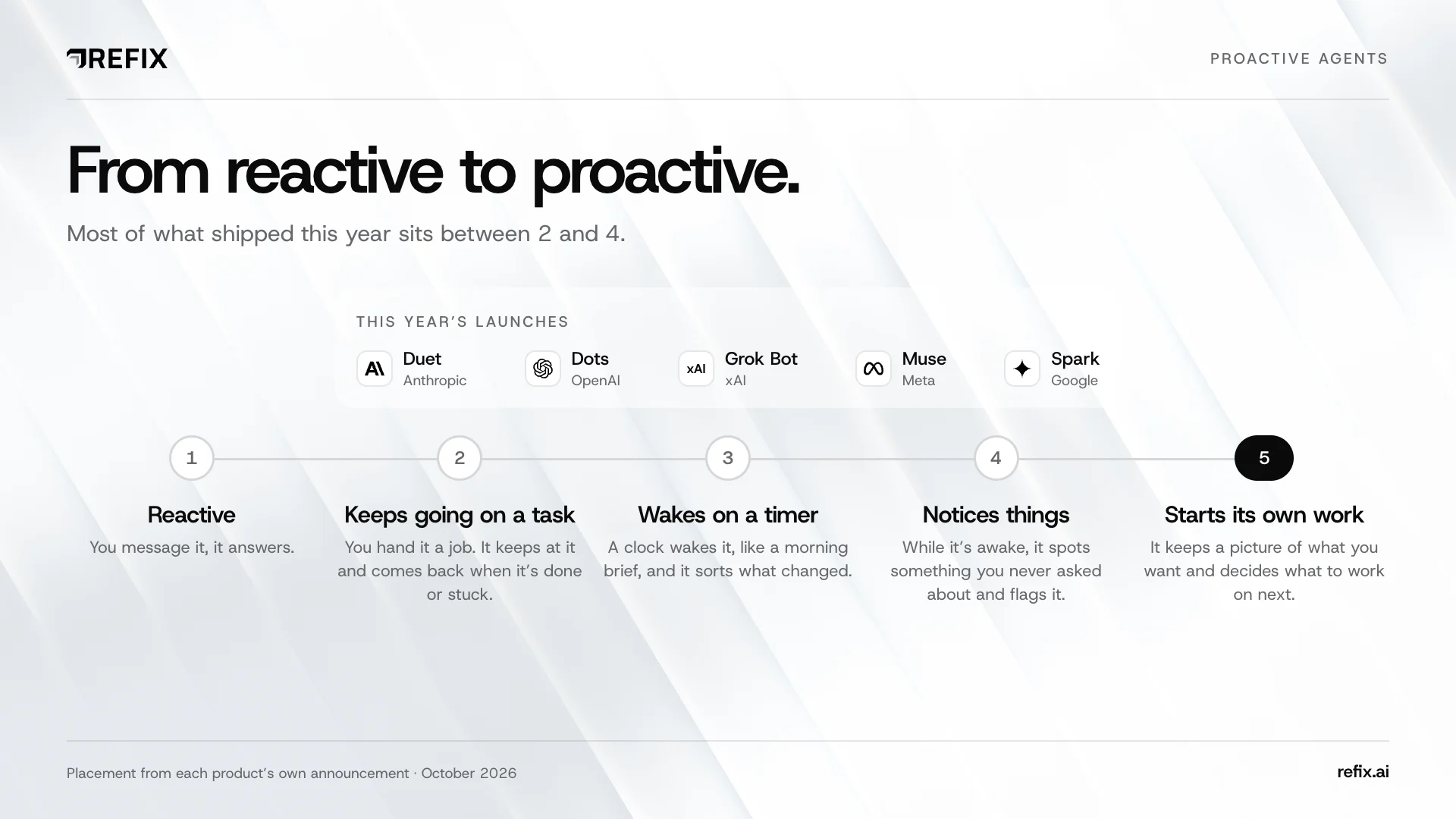
Most of what shipped this year sits somewhere between 2 and 4, and honestly they’re good at it. Anthropic describes Duet as “a new app where Claude works as a proactive agent”, one that “comes to you with what needs your attention, completes tasks you ask of it, keeps working when you step away”. And it does that well. But look at what proactive means there. It’s proactive inside the work you gave it. It’ll chase a task, pick it back up when it stalls. What it doesn’t do is start its own work.
There’s a good reason they stop there
- It’s expensive. Looking for new work costs a lot more than doing the work you were given, and most of the time there’s nothing to find.
- It’s risky. Nobody wants an agent inventing its own jobs inside their email or their bank account.
- There’s nothing to aim at. Your life doesn’t have one number to optimize. If an agent started its own work in your life, what would it even be going for?
But an organization is different
A growth team has the one thing your life doesn’t: a number. Trial-to-paid, 30-day retention, revenue. Give an agent that number and suddenly it has something to aim at when it goes looking for work.
The other two reasons get easier too. Investigating is still expensive, but finding one real leak pays for a lot of looking. And the risk is smaller, because most of the work is reading data and telling the right person what it found.
So a growth team can actually let an agent start its own work. And it needs one that does, because nobody hands a growth team a list of tasks. If you knew in advance which event would tell you retention is slipping, someone would’ve set up an alert for it years ago and it’d be a solved problem. Most of the job is figuring out what to look at next, which is exactly where today’s agents stop.
Building that is harder than it sounds, though. An agent that picks its own work can just as easily pick the wrong work, or ping people about nothing all day. Here’s what we’ve found it actually needs.
To pick the right work, at the right time
- Goals with no finish line. A personal agent knows when “book me a table for Friday” is done. “Improve 30-day retention” never is. The cause could be anywhere, and the work takes weeks. So the agent has to hold onto the number, remember what it’s tried, and pick things back up on its own.
- Deciding when to look next. A fixed schedule doesn’t work. Check every hour and you burn money on nothing. Check weekly and you find the leak a week late. Events don’t help either, since a slow drift never fires one. So the agent sets its own next wake-up, with a reason, like “nothing moves before Thursday’s release”.
- Deciding what’s worth starting. If every small dip starts an investigation, the bill blows up and people stop reading. Set the bar too high and it misses the leak. So it needs a real reason to start: something it saw, a rough sense of what it’s worth, and a finish line where the number moves. “Sent a message” isn’t done.
- Keeping up with a company that keeps changing. Priorities shift every week, and nobody has time to teach an agent. It has to work out what people are focused on and who a finding matters to. Our first version picked work that kept it busy. At one company, 14 of 16 of its investigations ended with two cold messages to someone who’d never used Refix, and no reply. Now it follows what people are already working on.
To not turn into noise
- Knowing when to say nothing. Most days nothing is the right answer, and it should be able to say why it stayed quiet. If someone ignores the same thing twice, it stops. An agent that always has something to say gets muted in a week, and getting muted is how agents die.
- Earning the right to act. It starts by reading and telling, not doing. It never changes your data. You decide who it can reach, how often, and what needs your OK, and you hand it more as it earns it.
Refix does all of this. You give it a goal like trial-to-paid or 30-day retention. It decides what to look into, works out why the number is stuck, and follows up with the people who can fix it, until the number moves. That’s how it found the $630k at stake for our customers.
If you want to try it on your own numbers, it’s at refix.ai. And I’ll be writing up how we built each thing on that list, if you’re building something similar.