


TL;DR
- Reduce churn by separating voluntary cancellation from a failed renewal before selecting a retention tactic.
- A cancellation reason is a routing signal for product, plan, or offer work, not a universal diagnosis.
- Billing grace period and payment recovery address a different state from a subscriber who chose to cancel.
- A save offer for an active subscriber and a win-back offer for a lapsed subscriber need different eligibility rules.
- Measure each change against the affected cohort and state rather than one blended churn total.
A churn chart goes up, and the reflex is to add a discount or send another reminder. That can be the wrong move. Someone who cancelled because the app no longer fits their routine is in a different state from someone whose card did not collect. Reducing churn starts by finding out which state increased.
The job is less about one retention trick and more about matching the next action to the subscriber’s last event. Keep voluntary cancellation, payment recovery, active saves, and lapsed win-back work in separate lanes. The measurement becomes cleaner and the customer message makes more sense.
What is the first step to reduce churn?
Split the loss before you decide how to reduce it. Churn analysis is the diagnosis guide for that work: separate voluntary cancellation from failed-payment loss, then segment each side by cohort, plan, and lifecycle stage.
Apple’s cancellation reasons report provides a useful platform-level distinction. Its labels include Billing Issue, Price Increase Notice, Price Increase Consent, Canceled, Removed From Sale, and Other. Billing Issue describes a subscription that ended because the subscriber could not be billed. It belongs in a payment-recovery review, not in a generic cancellation save campaign.
| Subscriber state | What happened | First place to work |
|---|---|---|
| Voluntary cancellation | The subscriber turned off renewal | Product value, plan fit, price or cancellation context |
| Failed renewal | The renewal did not collect | Billing status, grace period, payment update path |
| Active but cancellation pending | The subscriber turned off renewal but still has access | Eligibility-aware save offer or a better plan fit |
| Lapsed subscriber | Access ended and the subscriber may return | Win-back eligibility and a return path |
This first split stops a report from pointing every lost subscription at the same fix. It also prevents a team from mistaking payment trouble for a product objection.
How do you reduce voluntary churn?
Voluntary churn asks whether the subscription kept earning its renewal. Apple says subscription apps should provide ongoing value and regularly update the app experience. Its subscription guidance also calls out tools for subscribers to see status, upgrade, crossgrade, downgrade, and manage or turn off auto-renewal.
That is not a template for one screen. It is a useful operating question: what value did this segment receive before it decided not to renew?
Start with the group that moved, not every subscriber at once. If first-renewal cancellations rose in one plan, review that plan’s onboarding, the first outcome a subscriber is meant to reach, and the moments where the app asks them to return. If a long-tenure annual segment moved after a price change, review plan fit and the price-change context before changing new-user onboarding.
| Signal in the cohort | A question to investigate | Possible owner |
|---|---|---|
| First-renewal cancels | Did subscribers reach the paid outcome before renewal? | Onboarding or product team |
| Plan downgrades before cancel | Does a lower tier fit the way this segment uses the app? | Pricing or packaging owner |
| Repeated cancellation reason | Is there one product or expectation gap behind the label? | Product or support owner |
| Price-event cancellation | Did the affected plan and notice timing match the subscriber’s expectation? | Pricing and lifecycle owner |
Use the reason as a route, not a verdict. Apple’s Canceled label can include in-app survey answers, but it is still only the group that cancelled and was recorded in that category. Subscription cancellation reasons explains the report labels and the distinction between the store taxonomy and an in-app survey.
How do you reduce failed-payment churn?
A failed renewal needs a different sequence. On Apple, Billing Grace Period lets a subscriber keep access to paid content after an auto-renewal fails because of a payment issue while Apple continues trying to collect. Apple offers 3-, 16-, and 28-day options, with a six-day cap for weekly subscriptions when the longer settings are selected.
The store state should decide the message and access rule. Apple says apps still need to validate purchases and account for renewal status to identify a subscription in Billing Grace Period. Do that before labeling access as lost or asking a customer to start over.
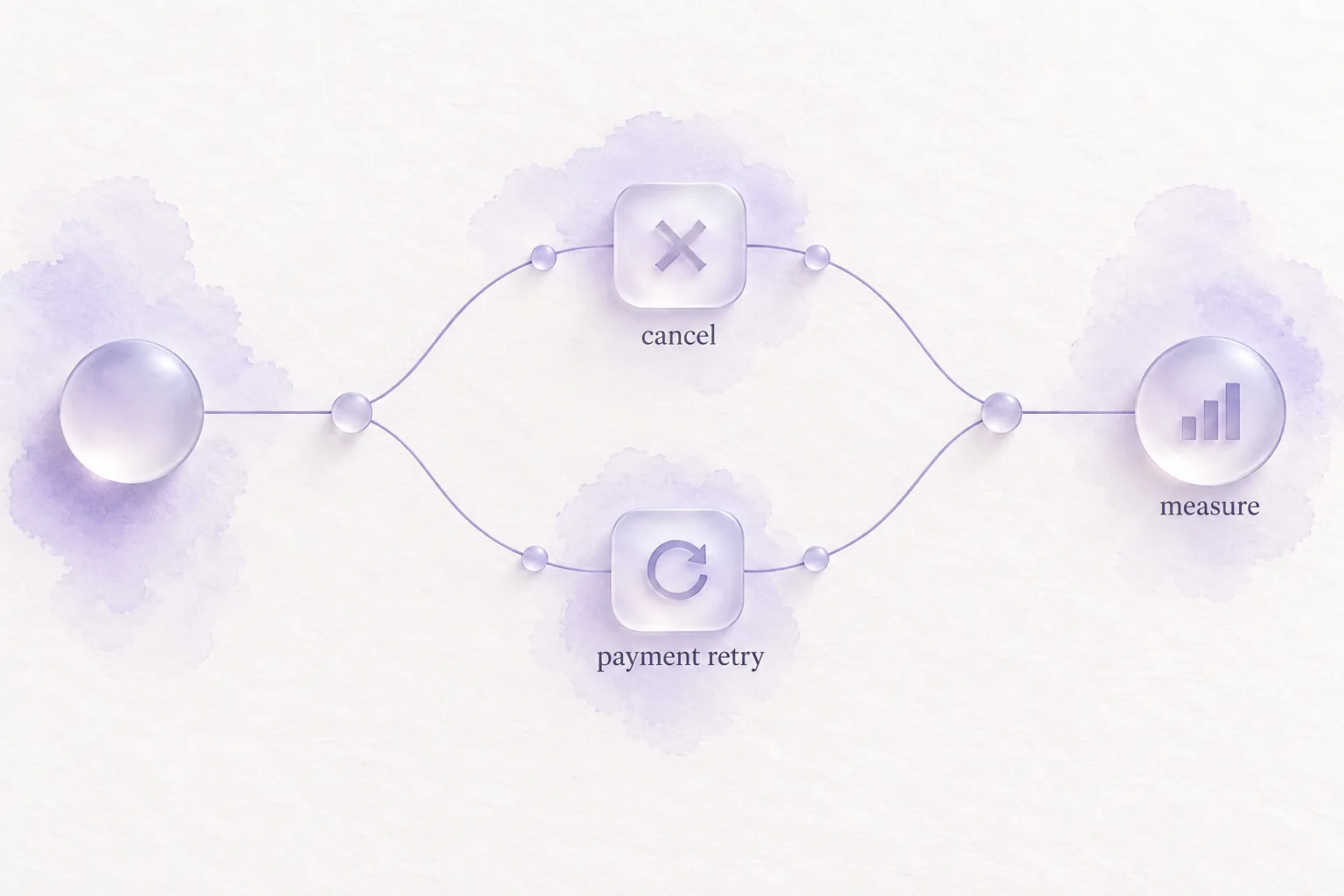
The practical question is not “how many reminders should we send?” It is “what state is this subscriber in, and what can they do next?” Failed payment recovery for subscription apps covers the retry, grace-period, and payment-update path in detail.
When should you use save offers and win-back offers?
An active subscriber who has turned off auto-renewal is not the same as a lapsed subscriber. Apple describes offer codes as a way to acquire, retain, and re-acquire subscribers with a free or discounted subscription for a limited time. Its promotional offers guidance includes save offers for subscribers who turned off auto-renewal but have not yet expired.
Apple’s win-back offers are for lapsed subscribers who may re-subscribe. Apple says these offers are configured per subscription product, not per subscription group, and can be displayed in the App Store, in the app, and in Manage Subscriptions for eligible customers.
| Moment | Subscriber status | Decision to make |
|---|---|---|
| Save | Auto-renewal is off, access has not expired | Is an eligible offer or plan change better than letting the subscription lapse? |
| Win back | Subscription has lapsed | Is the subscriber eligible to re-subscribe through the configured win-back path? |
| Payment recovery | Renewal failed | Does the current store state call for payment recovery rather than a discount? |
Keep eligibility and the expected state in the same event record. A broad offer sent to someone whose payment failed can hide the real action, which is updating payment and waiting for the platform recovery path.
How should a team run churn-reduction work?
Pick one state, one cohort, and one change. The review can stay practical:
- Find the voluntary-cancel or failed-payment segment that changed.
- Name the cohort, plan, lifecycle stage, and store state behind it.
- Read the associated product use, cancellation context, or payment status.
- Choose one owner and one change that fits that state.
- Compare the next eligible cohort with the same definitions.
- Keep the churn total, the voluntary-cancel rate, and failed-payment recovery separate in the report.
A change that reduces cancellations but does not affect failed payments can still be a good result. It should show up in its own line. Net retention rate gives the revenue view after you have separated expansion, contraction, and churn. Use gross vs net retention when upgrades may be covering a base that is still leaking.
Refix is built to connect product, subscription, and support signals, so teams can trace a churn movement from its cohort back to the last state a subscriber saw and the work that fits it.
See how Refix connects the signals behind retention work.
FAQ
- How do you reduce churn?
- Start by separating subscribers who chose to cancel from subscribers whose renewal failed. Improve ongoing value and plan fit for voluntary cancellations, use the store's payment-recovery states for failed renewals, and measure each action by the cohort it affected.
- What is the first step to reduce churn?
- The first step is to split voluntary cancellation from involuntary churn caused by a failed renewal. The two paths need different data, owners, and retention actions.
- Can cancellation reasons help reduce churn?
- Yes. Cancellation reasons can point toward a product, price, plan-fit, or timing problem, but they should be read with cohort, plan, product-use, and support context. They do not explain failed payments.
- How do you reduce involuntary churn?
- Use the subscription platform's payment-recovery states. On Apple, Billing Grace Period can preserve access while Apple continues attempting to collect a failed renewal. Validate the current purchase state before choosing a message or access rule.
- Are win-back offers the same as cancellation save offers?
- No. A save offer addresses an eligible subscriber who has turned off auto-renewal but has not expired. A win-back offer is for a lapsed subscriber who may re-subscribe.