


TL;DR
- CAC payback is the time a cohort's gross profit needs to recover its assigned acquisition cost.
- Use one documented CAC definition across the channels and periods you compare.
- Monthly gross profit should start with the revenue basis your business receives, not just the paywall price.
- Free trials, annual plans, refunds, and retained subscriber months can change the payback calculation.
- Compare paid and blended CAC separately when organic acquisition is meaningful.
CAC payback period gets tense when a campaign looks good in the ad account but the subscription cohort has not paid back its cost. The install count is there. So is the first purchase. What is still unknown is how many retained subscriber months the campaign needs before the return catches up with the cost.
The calculation does not need a universal benchmark to be useful. It needs a stable cohort, a clear acquisition-cost definition, and a monthly gross-profit figure that uses the same revenue rules every time.
What is CAC payback period?
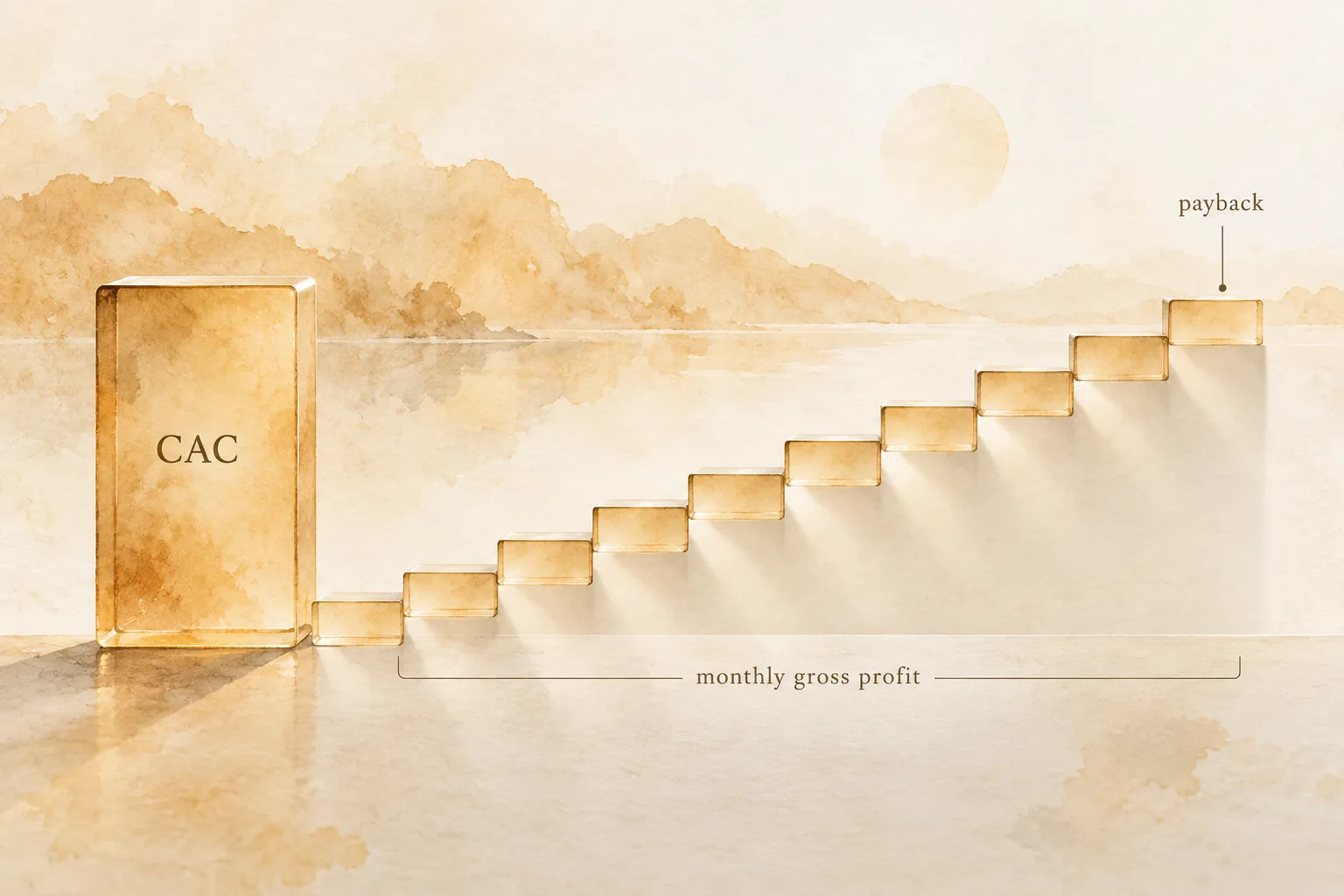
CAC payback period is the number of months it takes for gross profit from a newly acquired customer cohort to recover the acquisition cost assigned to that cohort. A shorter period means the cohort returned its assigned acquisition cost sooner. It does not say whether the channel will stay efficient as spend scales.
At the cohort level:
CAC payback period in months =
acquisition cost for the cohort / monthly gross profit from that cohort
A public-company filing can use a more elaborate version of the same idea. Klaviyo’s S-1/A defines CAC payback as the number of months needed for non-GAAP gross profit to exceed adjusted sales and marketing expense. Your app does not need Klaviyo’s exact formula. It does need to say what its own numerator and return measure include.
The SEC’s guidance on key performance indicators makes the same practical point: define how a metric is calculated and disclose estimates or assumptions when they are needed for someone to understand it. Treat the payback calculation as a documented operating definition, not a number that can float from one review to the next.
How do you calculate CAC payback period?
For a subscription app, a per-subscriber version makes the parts easier to inspect:
CAC per new paying subscriber = acquisition cost / new paying subscribers

Monthly gross profit per active subscriber =
monthly net subscription revenue per active subscriber - variable serving cost per active subscriber

CAC payback period = CAC per new paying subscriber / monthly gross profit per active subscriber
The cohort-level and per-subscriber versions should agree when they use the same people and time period. Choose one as the reporting standard and keep the other as a check.
| Input | Question to settle | Keep consistent across |
|---|---|---|
| Acquisition cost | Does it include media only, or also selected creative, tooling, and onboarding costs? | Channels and reporting periods |
| Customer count | Is the denominator all acquired customers or new paying subscribers? | CAC and return calculation |
| Revenue basis | Is it customer price, gross sales, or net proceeds? | Monthly gross-profit rows |
| Gross margin | Which variable serving costs are subtracted? | Cohorts and plans |
| Time basis | Are you using collected cash or revenue recognized by month? | Especially annual plans |
The numerator deserves attention. Google Ads defines its cost metric as the sum of CPC and CPM costs during the period. That is a clean media-spend input, but it is not automatically your full CAC. If a team includes agency fees, creative production, or onboarding work, it should use that same definition for every channel it compares.
What counts as monthly gross profit in an app?
Start with the revenue the business records under its chosen rule, then subtract the variable costs required to serve that active subscriber. Do not substitute the price printed on the paywall without checking what the store report says.
Apple states in its subscription overview that developers receive 70 percent of a subscription price during a subscriber’s first year of paid service, minus applicable taxes, and 85 percent after one year of paid service, with different terms for Small Business Program participants. Google Play says apps and in-app products sold through Play Billing are subject to a service fee, and its fee rules vary by market and program.
That does not mean every app should apply one hard-coded store-fee percentage. Pull the proceeds or earnings value from the report you use, document its treatment of fees, taxes, and refunds, and use that basis in every cohort.
| Revenue or cost line | Treatment for the calculation |
|---|---|
| Subscription proceeds | Include using the selected store or merchant report basis |
| Refunds | Include or exclude consistently, then label the rule |
| Variable serving costs | Subtract costs that rise with active subscriber use under your definition |
| Fixed product costs | Keep separate unless the team deliberately uses a fully loaded margin definition |
| Annual-plan cash | Do not call the full payment one month of recurring gross profit without saying so |
A CAC payback period example
Imagine a January paid-acquisition cohort. The numbers below are hypothetical arithmetic, not a benchmark or a customer result.
- Acquisition spend: 18,000 dollars
- New paid subscribers: 300
- Net subscription proceeds per active subscriber per month: 7 dollars
- Variable serving cost per active subscriber per month: 1 dollar
First, calculate CAC per new paid subscriber:
18,000 dollars / 300 = 60 dollarsThen calculate monthly gross profit per active subscriber:
7 dollars - 1 dollar = 6 dollarsIf all 300 subscribers were active for the first monthly view, the cohort produces 1,800 dollars in monthly gross profit. The simple payback result is:
18,000 dollars / 1,800 dollars = 10 monthsIn a real cohort, people will not all remain active for ten months. Recalculate the monthly gross-profit line using the active paid subscribers and actual proceeds in each period. That turns a planning estimate into a cohort record.
How should app teams track CAC payback?
Track payback by the cohort that received the spend. A useful table has a spend month, channel, campaign, country, store, plan, offer, trial status, first paid date, and monthly active-paid-subscriber count. It should also retain the written definition of CAC and gross profit used for that table.
Keep paid CAC apart from blended CAC. Paid CAC assigns a paid channel’s cost to the customers attributed to it. Blended CAC spreads a wider acquisition cost across a wider customer count. Both can be useful, but they answer different questions.
The return side needs the same discipline. A cohort that pays on an annual plan may create a large cash collection in its first month but deliver access across a year. State whether the review uses cash collected or revenue recognized by month. Do not compare that answer with a monthly-plan cohort calculated on a different basis.
Use customer lifetime value next to payback. LTV shows what a cohort has produced over a stated window. CAC payback shows when the gross profit from that cohort catches up with the acquisition cost.
What can make CAC payback look better than it is?
The fastest way to lose confidence in a payback report is to let its components change in the background. Watch for these errors:
- Counting a free trial as a paying subscriber before it converts.
- Using customer-facing list price instead of the proceeds basis selected for the business.
- Treating annual-plan cash as a single month of recurring gross profit without labeling it.
- Adding organic customers to a paid channel’s denominator.
- Ignoring refunds or applying them differently from one cohort to the next.
- Counting upgrades from an old cohort as though they came from the newly acquired one.
Retention is part of the timeline, not an adjustment to hide later. Net retention rate shows how expansion, contraction, and churn affect cohort revenue. If the payback curve drops because renewals did not collect, churn analysis helps separate failed payment from a subscriber’s decision to leave.
Refix is built to connect acquisition, product, subscription, and support signals, so the time-to-payback discussion can start with the cohort behind it instead of a blended dashboard average.
See how Refix connects acquisition and subscription signals.
FAQ
- What is CAC payback period?
- CAC payback period is the time it takes for gross profit from an acquired customer cohort to recover the acquisition cost assigned to that cohort. It is usually expressed in months.
- How do you calculate CAC payback period?
- Divide the acquisition cost assigned to a cohort by the monthly gross profit that cohort produces. Per subscriber, divide CAC per new paying subscriber by monthly gross profit per active subscriber.
- What should be included in CAC payback?
- State what the acquisition-cost numerator includes, such as media spend and any chosen marketing or onboarding costs. Use a consistent net-revenue and gross-margin definition for the monthly return.
- Should CAC payback use gross sales or net proceeds?
- For a subscription app, net proceeds or another stated revenue basis is usually more useful than the customer-facing price because store fees, applicable taxes, and refunds affect what the business receives. The important part is consistency.
- Do free trials count in CAC payback period?
- Free trials can be part of the acquired cohort, but they should not be counted as paying subscribers before conversion in a per-paying-subscriber calculation. Keep the denominator aligned with the return you measure.