Slack



TL;DR
- ARPPU is revenue divided by the paying users included in the same window.
- State whether the revenue is gross, net of refunds, recognized, or realized.
- ARPU uses all users, while ARPPU uses paying users.
- A cohort ARPPU and a calendar-period ARPPU answer different questions.
- Pair ARPPU with payer conversion and retention before changing pricing.
A paid subscriber opens the app twice in a week. Another pays once and disappears. If both are included in one revenue average, the result is only useful when the team says which users and dates it used.
ARPPU, or average revenue per paying user, is revenue divided by the paying users in a defined period or cohort window. It is a monetization metric, not a complete picture of app value. The definition around the numerator and denominator determines what the number can tell you.
What is the ARPPU formula?
The basic formula is:
ARPPU = revenue attributed to paying users / number of paying usersFor a calendar period, include the revenue and paying-user count from that period. For a cohort, use the same cohort in both places. A 30-day cohort view, for example, asks how much revenue the cohort produced in its first 30 days per paying user in that cohort. It is not the same as dividing a month’s total revenue by the month’s active payers.
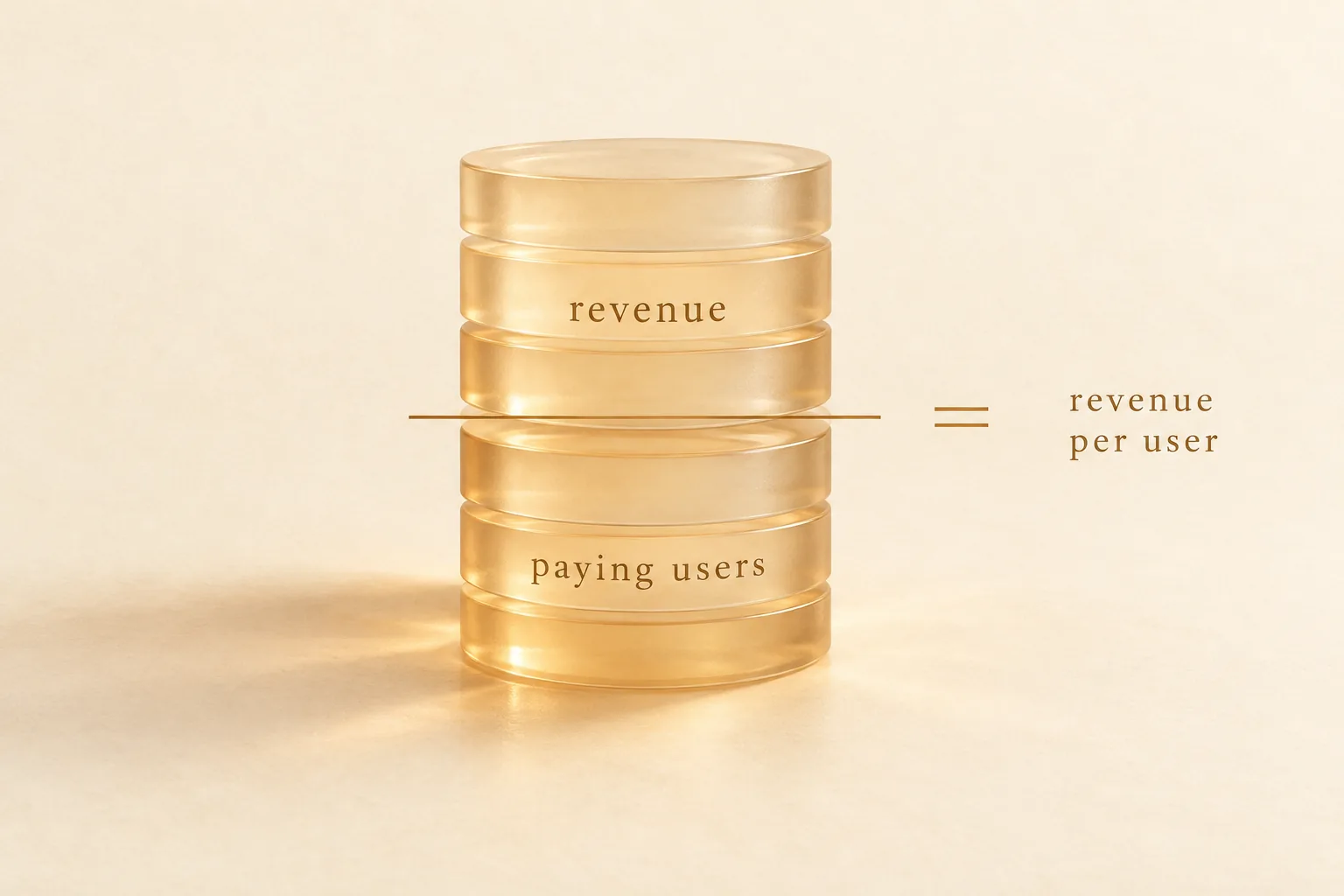
Suppose an app records $12,000 of defined revenue from 800 paying users in April:
$12,000 / 800 paying users = $15 ARPPUThat $15 is not a promise about what each person paid. It is an average for the stated population and window. A different result can be correct if it uses net revenue, a new-user cohort, or a different definition of payer.
What should count as revenue and a paying user?
Choose the accounting rule before you compare weeks. A report might use customer price, recognized revenue, proceeds after a platform share, or revenue after refunds. Those values are not interchangeable.
Record the decisions with the metric:
| Definition choice | Question to answer |
|---|---|
| Revenue basis | Gross sales, proceeds, recognized revenue, or net of refunds? |
| Time window | Calendar period, rolling window, or cohort age? |
| Paying user | Any user with a transaction, active payer, or new payer? |
| Products | One subscription, all purchases, or subscriptions plus consumables? |
| Currency | Store currency, reporting currency, and conversion date? |
Provider dashboards can use their own names for similar ideas. RevenueCat’s realized LTV per paying customer documentation describes cumulative realized revenue over new paying customers for a selected lifetime window. Adjust’s metrics glossary documents revenue-per-paying-user metrics for selected cohort periods. Use those definitions when reproducing a provider chart, but do not silently turn a cohort LTV measure into a monthly ARPPU number. Use those definitions when reproducing a provider chart, but do not silently turn a cohort LTV measure into a monthly ARPPU number.
What is the difference between ARPU and ARPPU?
ARPU divides revenue by all users in the chosen population. ARPPU divides revenue by paying users only.
| Metric | Denominator | Useful question |
|---|---|---|
| ARPU | All users | How much revenue does each user represent on average? |
| ARPPU | Paying users | What revenue does each payer represent on average? |
| Payer conversion | All users | What share became payers? |
| LTV per paying customer | Paying customers in a cohort | How much realized revenue accumulated over a defined lifetime window? |
ARPPU can rise while total revenue falls if a smaller group of high-value payers remains. It can also fall when a price change attracts more low-priced payers. Read the payer count, payer conversion, and retention beside it.
How should an app team use ARPPU?
Start with one stable report definition. Break it down by plan, country, acquisition source, billing interval, and cohort age when the sample supports the comparison. Avoid changing the denominator every week because a segment looks inconvenient.
When ARPPU moves, ask which part moved first:
- Did the number of paying users change?
- Did the mix of plans or products change?
- Did refunds, renewals, upgrades, or downgrades change?
- Did the revenue source or attribution window change?
- Did the same cohort retain and pay differently?
The customer lifetime value calculator guide covers a longer-horizon value calculation. For the choices around paid products and subscriptions, see app monetization.
ARPPU should support a decision, not become a target to raise in isolation. A pricing change that lifts payer value but reduces qualified conversion or retention may not improve the customer journey.
Refix is built to connect revenue, product, and support signals so a movement in payer value can be investigated alongside what customers actually did.
See how Refix connects the signals behind revenue.
FAQ
- What is ARPPU?
- ARPPU means average revenue per paying user. It is the revenue attributed to paying users in a stated period or cohort window divided by the number of paying users included in that definition.
- How do you calculate ARPPU?
- Divide the defined revenue for the period or cohort by the number of paying users in that same period or cohort. State how refunds, taxes, platform fees, and currency conversion are treated.
- What is the difference between ARPU and ARPPU?
- ARPU divides revenue by all users, while ARPPU divides revenue by paying users. ARPPU therefore does not describe the value of a non-paying user or the conversion rate to paid.